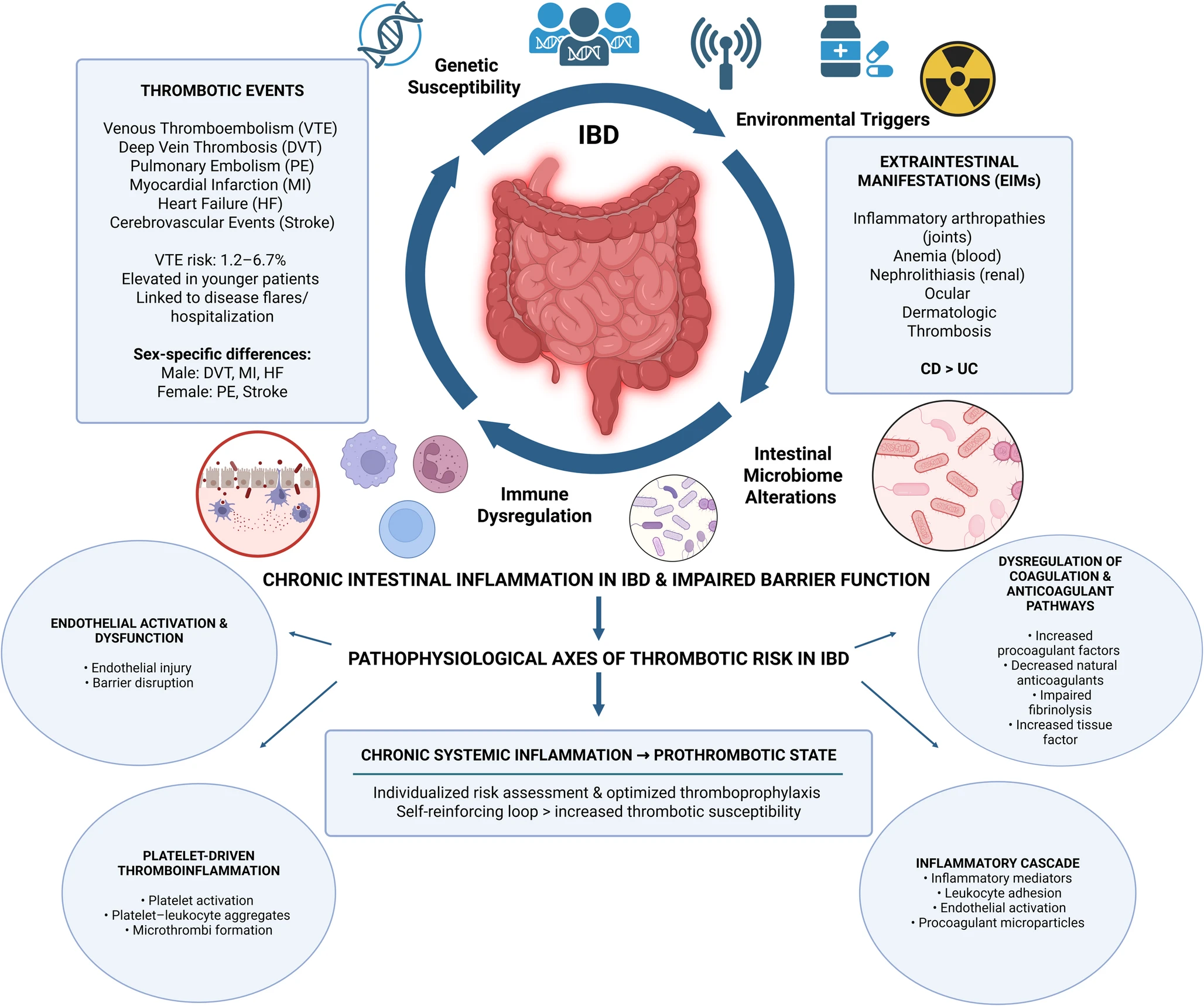
Inflammatory bowel disease (IBD), which includes Crohn’s disease and ulcerative colitis, encompasses chronic conditions whose effects may extend beyond the digestive system. Manifestations outside the intestine, known as extraintestinal manifestations (EIMs), can affect various organs and significantly influence quality of life. Their prevalence varies across studies, with commonly reported estimates suggesting that they affect approximately 25-40% of patients.
Extraintestinal manifestations may involve the joints, skin, eyes, liver and other organs. In some patients, they occur before the underlying intestinal disease is recognised. Their course is not always directly related to the activity of intestinal inflammation, further highlighting the importance of comprehensive assessment and collaboration among specialists from different disciplines.
Early recognition of these changes and assessment of individual risk remain important research and clinical challenges. In particular, a better understanding is needed of which patient characteristics may signal the development of complications and how different findings can be integrated into a comprehensive picture of the disease.
The AI-IBD project focuses on detailed clinical characterisation of patients with inflammatory bowel disease, with particular emphasis on systemic and subclinical changes that have not yet manifested as prominent symptoms. We investigate the relationships between disease activity and inflammatory, cardiometabolic and hormonal markers, cardiovascular function, lifestyle habits and quality of life.
Previous studies by other research groups have demonstrated the potential of machine learning to link clinical, demographic and genetic characteristics with manifestations of IBD. Analyses of large patient populations also show that individual manifestations and associated conditions occur in interconnected patterns. Artificial intelligence and network analysis enable the investigation of these relationships and create opportunities to develop more precise approaches to risk assessment.
Within the AI-IBD project, we integrate clinical, laboratory, imaging and questionnaire data into a shared research database. On this basis, we plan to develop and validate machine learning models that could help identify patients at increased risk of developing disease manifestations beyond the digestive system. Particular attention is given to model reliability, the interpretability of their results and the evaluation of their performance using independent data.
The project’s value lies in its interdisciplinary approach, which brings together gastroenterological, cardiological, endocrinological, psychological and other specialist assessments. The long-term goal is to contribute to a better understanding of the systemic nature of IBD, earlier identification of patients at risk and the development of individually tailored approaches to their assessment and follow-up.
As part of the project, we examined the current use of artificial intelligence and machine learning in predicting outcomes in inflammatory bowel disease. We brought these findings together in a published systematic review of prognostic models for IBD.
The review provides insight into existing approaches, their predictive performance and methodological limitations. It particularly highlights the importance of reliable data, model validation in independent patient populations and assessment of clinical utility.
These findings guide the further development and validation of models within the AI-IBD project.
Read the published systematic review.
1. Šantić R, Pavlović N, Kumrić M, Vilović M, Božić J. Molecular determinants of thromboinflammatory activation in inflammatory bowel disease. J Mol Med (Berl). 2026;104(1):86. doi: 10.1007/s00109-026-02693-7 (Q1; IF 2025: 5.0).
2. Martinović L, Šantić R, Kumrić M, Vilović M, Martinović D, Božić J. Interpreting biomarker discordance in inflammatory bowel disease: beyond fecal calprotectin and C-reactive protein. Biomedicines. 2026;14(9):1883. doi: 10.3390/biomedicines14091883 (Q2; IF 2025: 4.5).
3. Šantić R, Kumrić M, Vilović M, Pavlović N, Rušić D, Bukić J, et al. How gut microbes transform dietary phytonutrients: enzymatic pathways and human metabolite exposure. Molecules. 2026;31(16):2895. doi: 10.3390/molecules31162895 (Q2; IF 2025: 5.1).
4. Vrdoljak J, Vilović M, Šantić R, Kumrić M, Pavlović N, Maleš I, et al. How ready are machine-learning prognostic models for inflammatory bowel disease? A systematic review and PROBAST + AI appraisal of 111 studies. Mach Learn Knowl Extr. 2026;8(8):232. doi: 10.3390/make8080232 (Q1; IF 2025: 8.4).
5. Plosnic Todoric MR, Santic R, Kumric M, Zivkovic PM, Olic I, Rusic D, et al. Blunted cortisol awakening response in patients with inflammatory bowel disease: a cross-sectional case-control study. Med Sci (Basel). 2026;14(4):463. doi: 10.3390/medsci14040463 (Q1; IF 2025: 5.9).
6. Šantić R, Kumrić M, Martinović L, Pavlović N, Rizikalo A, Vilović M, et al. Postprandial inflammatory stress: a hypothesis-generating framework linking metabolic, immune and vascular responses. Life (Basel). 2026;16(8):1298. doi: 10.3390/life16081298 (Q1; IF 2025: 3.9).
7. Božić J, Šantić R, Živković PM, Kumrić M. Diet, gut microbiome, and microbial metabolites in inflammatory bowel disease: from functional dysbiosis to precision nutrition. Int J Mol Sci. 2026;27(12):5262. doi: 10.3390/ijms27125262 (Q1; IF 2025: 5.6).
8. Šantić R, Martinović L, Pavlović N, Martinović D, Vrdoljak J, Kumrić M, et al. Natural bioactive compounds targeting gut barrier integrity and metabolic endotoxemia in cardiometabolic disease: mechanistic insights and translational perspectives. Molecules. 2026;31(11):1840. doi: 10.3390/molecules31111840 (Q2; IF 2025: 5.1).
9. Šantić R, Kumrić M, Martinović L, Vilović M, Jerončić Tomić I, Cvitković I, et al. Extra-virgin olive oil phenolics in IBD-associated vascular risk. Molecules. 2026;31(11):1827. doi: 10.3390/molecules31111827 (Q2; IF 2025: 5.1).
10. Olić I, Pavlović N, Kumrić M, Šantić R, Bratanić A, Božić J. Microbiota-derived metabolites and cardiovascular implications in inflammatory bowel disease (IBD). Mol Med. 2026;32:90. doi: 10.1186/s10020-026-01493-6 (Q1; IF 2025: 8.3).
11. Dohoczky D, Šantić R, Mustapić S, Knežević B, Kumrić M, Banić M, et al. A narrative review of sex-related differences in inflammatory bowel disease-associated cardiovascular and thrombotic risk: epidemiology, mechanisms, and prevention strategies. Transl Gastroenterol Hepatol. 2026;11:112. doi: 10.21037/tgh-2026-0075 (Q2; IF 2025: 3.3).
The AI-IBD project investigates inflammatory bowel disease by integrating data on the digestive system with other aspects of health. We are particularly interested in disease activity, laboratory and hormonal markers, cardiovascular function, lifestyle habits and quality of life.
This approach helps us investigate why disease characteristics differ between patients and which data could be useful for their future monitoring.
For information about the project and opportunities to participate, please contact the research team.
Principal Investigator: Professor Joško Božić, PhD
Institution: University of Split School of Medicine
Address: Šoltanska 2A, 21000 Split
Email: josko.bozic@mefst.hr
Please use this contact for enquiries about the research, opportunities to participate and scientific collaboration.
Print page